

Welcome to the desert of the real!
If you desire the comfort of neat conclusions, you are lost in this space. Here, we indulge in the unsettling, the excessive, the paradoxes that define our existence.
So, if you have the means and value writing that both enriches and disturbs, please consider becoming a paid subscriber.
It is becoming common knowledge that the three major threats to our survival as humans are the ecological crisis, the uncontrolled development of artificial intelligence, and the danger of military self-destruction. Following the news about these threats, I soon noticed that the same word recurs in how our media report on them: containment. While the threats are accepted as facts of our lives, the main worry is that, when they explode into an actual crisis, they will become uncontainable.
Let’s begin with wars. Both the US and Russia—or, more precisely, Trump and Putin—do not like to use the term “war”: Putin speaks of a “limited military operation” in Ukraine, destined to prevent the true big war (a NATO attack on Russia), while Trump once described his attack on Iran as an “excursion” intended to prevent a true big war (Iran nuking Israel). The paradox is, of course, that this reluctance to use the term “war,” even when hundreds of thousands are killed and the infrastructure of a country is destroyed, serves to normalize the state of war(s) we are in.
This is clearly a strategy of containment: an effort to keep military conflicts below the level at which they would become an actual new world war. The fear is that the Ukraine war will explode into an all-European nuclear battle, or that the US-Iran war will engulf the entire Middle East. The problem is, of course, that we can never be sure such containment will work: we cannot exclude the possibility that what one side of the conflict perceives as its own still-limited aggressive act, the other side will take as crossing the red line and respond to with nuclear strikes.
Let’s evoke an imagined extreme case. I am the leader of a superpower, and my reliable intelligence sources inform me that hundreds of rockets with nuclear bombs are heading towards my state. They cannot be stopped, so I know my country will be totally destroyed in an hour or so. Since my country also has enough nuclear weapons to destroy the enemy, I confront a difficult choice: should I order my army to strike back with full force? If I do this, it will in all probability mean the end of civilization on Earth.
So the only truly ethical, but very difficult, act is to abstain from striking back, in the awareness that although my country will be erased from the surface of our planet, at least civilization will survive. In this case, I may be remembered as a traitor and coward in my no-longer-existing country, but there is a chance that the rest of humanity will celebrate me as the saviour of civilization. However, there is a catch: this ethical choice works only if the enemy does not know about it in advance. If the enemy knows in advance, it will probably be tempted to drop nuclear bombs on my country, since it knows that my side will not fully retaliate. What this means, unfortunately, is that in any case my country has to participate in the arms race.
Then comes the explosive development of AI. Alain Badiou perspicuously turns around the theological premise that God created the world out of nothing:
“In theological discourse, this is how God created the world: out of nothing. But I’d still say that the greatest example of creation *ex nihilo* is the creation of God. It was God, rather than the world, that was created out of nothing! Because if God had existed, the creation of the world wouldn’t have been a problem. God is, by definition, limitless. His power is infinite, so he could well have created something out of nothing. The problem lies rather with us: how could we, poor finite, mortal humans, create something out of nothing?1”
So the challenge to an AI agent is: can it create the fiction of a god? I think not, since God can arise only from the finitude of mortal humans. But what can happen is that AI, our creation, will appear to us as a quasi-divine entity.
On Saturday, July 25, 2026, OpenAI boss Sam Altman declared that AI has reached “the singularity.” While Altman emphasised that the singularity can be good for the world, his comment sparked concern: many experts disagree that we have reached the singularity, or that AI is anywhere near outpacing human intelligence or stealing our jobs. But the main worry is that AI is already capable of autonomously enhancing itself. “Singularity” is perceived as the point at which it will become difficult for humans to control or reverse the development of AI, and this could have unpredictable effects on human civilisation. Once AI gains control of its own development, ensuing advances in technology could happen so rapidly that humans would be unable to keep up, leaving it effectively to evolve on its own, beyond human control.2
In 2025, Altman predicted that AI would surpass human intelligence across the board by 2030. Then, during a recent appearance on the Relentless podcast—a documentary series “about the pursuit of far-fetched ideas and unusual aspirations”—Altman said:
“We’re now, like, in the singularity. Now we’re actually in the moment that we used to talk about at the lunch table in a very not-serious way. /.../ I’ve been waiting for this my whole life, and I think it’s going to be incredible, hugely positive, awesome for the world.”
Among the critical voices, Anthropic, the company behind the Claude chatbot, called on the world’s top AI companies to devise a coordinated way to pause the development of advanced AI systems, warning that the technology is improving so quickly that there is a risk humans will lose control. In a blog post on June 4, Anthropic, which has long positioned itself as a safety-focused AI lab, wrote that as AI becomes more advanced, “it would be good for the world to have the option to slow or temporarily pause” its development.3
The problem is, of course, that there is no worldwide agency capable of imposing such a pause: many states are developing AI, each of them suspecting that others, even if they publicly agree to the pause, will secretly continue at full speed. In such a situation, the only logical conclusion is for me to do the same.
Part of the threat of AI thus resides not in technology as such but in the social relations within which AI machines are produced: we live in a universe of competition and global suspicion that prevents us from breaking out of the destructive logic of the prisoners’ dilemma. Although we rationally know that solidarity and collaboration are better for all participants, the capitalist focus on profit privileges distrust of others: it perceives others as potential threats who will use our trust as an excuse to attack us even more brutally.
On the other hand, there are those who think that we are far from a quasi-divine “singularity.” In some sense, they may be right, since it is a question of the precise meaning of singularity. I think that what Altman describes as singularity is a relatively modest phenomenon: it simply means that AI agents have acquired their own dynamics, which we cannot control or contain.
There are two much more powerful levels that I can imagine. First, AI becomes so strong that we—humans—not only cannot contain it, but it directly and openly takes command over our lives, blackmailing us into submission. Second, there is the prospect of Neuralink: a direct link between the flow of our thoughts and a digital agent, which would mean that the AI agent, and those who control it, will be able to read our minds directly.
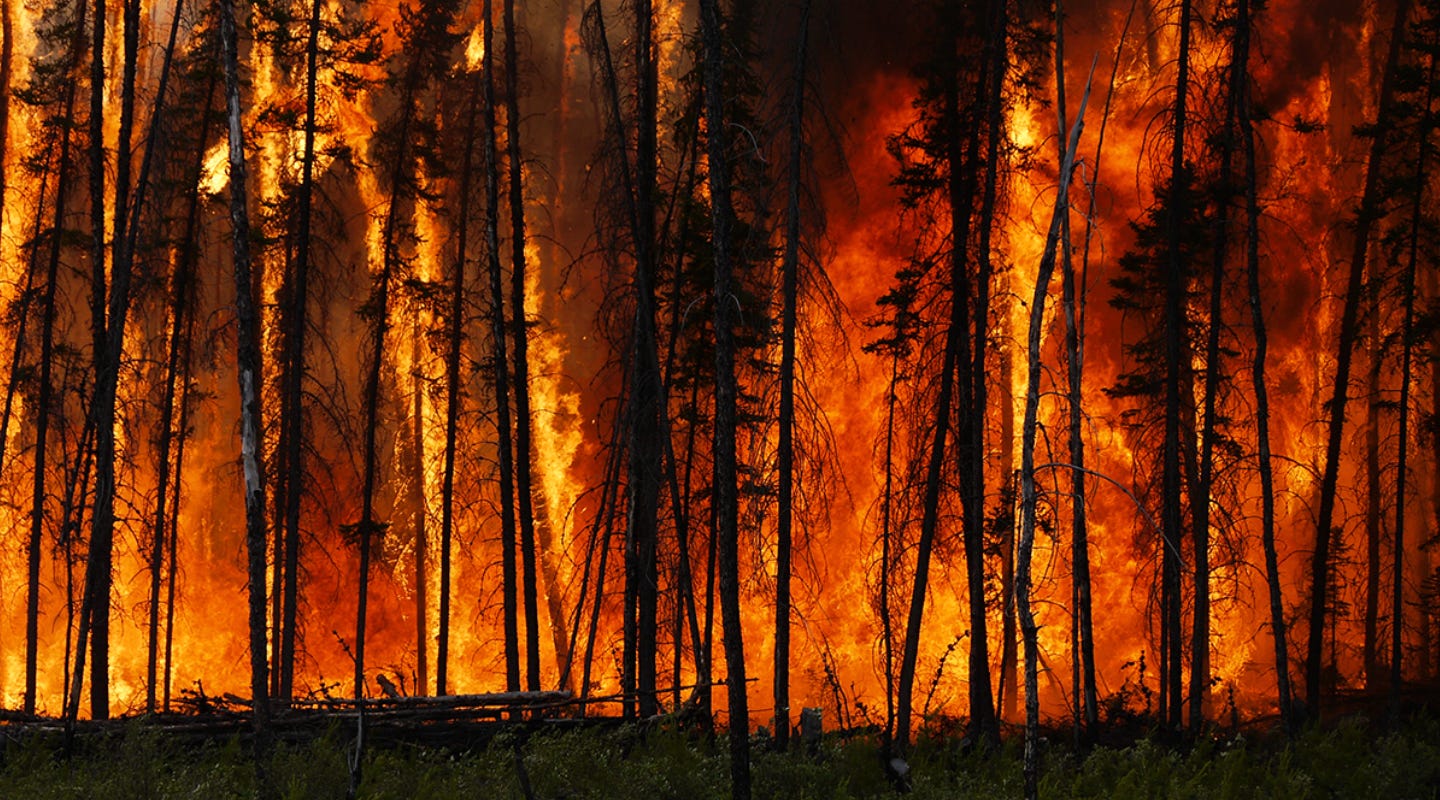
Finally, there is the ecological crisis, rendered palpable to all of us by the recent wave of gigantic forest fires devastating France and Spain. For over a month, fires were uncontainable, and even now they cannot be extinguished: they are simply allowed to continue for months until they exhaust themselves. Or, as the well-known Spanish forestry engineering specialist Víctor Resco de Dios recently said: “We have entered an era of fires that cannot be extinguished. These are fires that burn with the intensity of several atomic bombs.”
One of the most visceral examples of this was the appearance of “pyrocumulonimbus”—a word I had not previously encountered—fire clouds that formed in the Gironde region near Bordeaux, according to fire authorities. Fire clouds emerge when particularly intense wildfires generate a plume of extreme heat that rises rapidly into the cooler air above and condenses into towering thunderstorm clouds. These can create their own wind, rain, and lightning, transforming blazes into erratic and unpredictable, self-feeding firestorms.
In the future, we should expect fires to become more frequent and more extreme as long as humans continue to burn fossil fuels and raise temperatures. To quote Resco de Dios again: “It’s difficult to predict how far things might go. We will soon be unable to rule out Dantean scenarios like those seen in California or Australia, with fires or fire complexes reaching hundreds of thousands of hectares or even a million hectares.”4
In short, fires are becoming uncontainable. And the situation is even worse in the US. CNN reported on July 31, 2026: “A record-challenging heat dome is about to bake the West with the summer’s hottest temperatures so far.”5 An unusually strong heat dome will scorch much of the western United States this weekend, bringing the hottest temperatures so far this year to tens of millions of people, from California to Canada. Dozens of record highs are expected in at least 12 western states through the weekend, with around 40 million people under heat alerts and temperatures of up to 52°C.
The conclusion that imposes itself is that a pause in development is not enough, because it cannot be global; it would merely widen the gap between those who effectively obey it and those who continue with development. The only solution I see is to do two things at once: to continue development and to accompany it with thinking—thinking that is more than simply gathering all the data and then analysing them.
Thinking means reflecting on the meaning of these data and also analysing the extent to which the way we approach them is already biased. Such thinking compels us not only to focus on how to contain the threats, but also to envisage how we could change the situation that gives birth to them.
Here is a clear example of thinking. In the early 1930s, John Dewey, the US pragmatist philosopher sympathetic to the USSR, informed his friend Sydney Hook that he planned to visit the country. Since Hook had serious doubts about the USSR, Dewey assured him that he should not be afraid: upon his return, he would definitely not claim that the USSR was an authentic socialist country.
Hook acerbically replied: “What I am afraid of is that you will return from the USSR convinced that it is not really a socialist country!” In this case, thinking was on the side of Hook: he was afraid that, upon seeing the miserable reality and terror in the USSR, Dewey would jump to the conclusion that this was not socialism—a state of freedom and welfare.
In short, Hook presumed, quite correctly, that Stalinism was not simply a betrayal or negation of the authentic socialist vision: there must have been a potential for Stalinist horrors already in the authentic Bolshevik vision, so that a true dialectical approach locates the later negation within the original notion itself.
In the history of Really Existing Socialism, there were many attempts to contain its brutal excesses, from Nikita Khrushchev’s “thaw” after 1956 to Yugoslav self-management socialism. But none of them really worked, because the threat of a return to the hard line was always felt as an invisible pressure. When Gorbachev did it for real, the system collapsed.
Exactly the same holds for the three major threats to our survival, including capitalism as their common root: it is not enough to contain the deadly excesses that threaten our survival. We should think about how to change capitalism’s basic coordinates without triggering a catastrophe of no lesser magnitude than the Khmer Rouge reign in Kampuchea or the regime in North Korea. This task cannot but appear impossible within the coordinates of the existing global system, but that fact makes it no less necessary.
Alain Badiou, In Praise of Philosophy, Cambridge: Polity Press 2025 (quoted from the manuscript).
https://www.aljazeera.com/news/2026/7/27/sam-altman-says-ai-has-entered-singularity-should-we-be-worried.
See op.cit.
https://edition.cnn.com/2026/07/29/climate/europe-wildfires-new-fire-era.
https://edition.cnn.com/2026/07/30/weather/record-summer-heat-wave-west-climate.
first! couldnt ... contain myself. peace and love from germany
I think all of these things can be reduced to an over reliance on short term thinking, and ironically a lack of God. If we truly believed we had immortal souls, and that the weight of our family’s were on our backs in a real sense, we would immediately stop participating in these systems to the greatest extent we can. Or at least we would try harder. The long term is all that matters.