

Welcome to the desert of the real,
If you desire the comfort of neat conclusions, you are lost in this space. Here, we indulge in the unsettling, the excessive, the paradoxes that define our existence.
So, if you have the means and value writing that both enriches and disturbs, please consider becoming a paid subscriber.
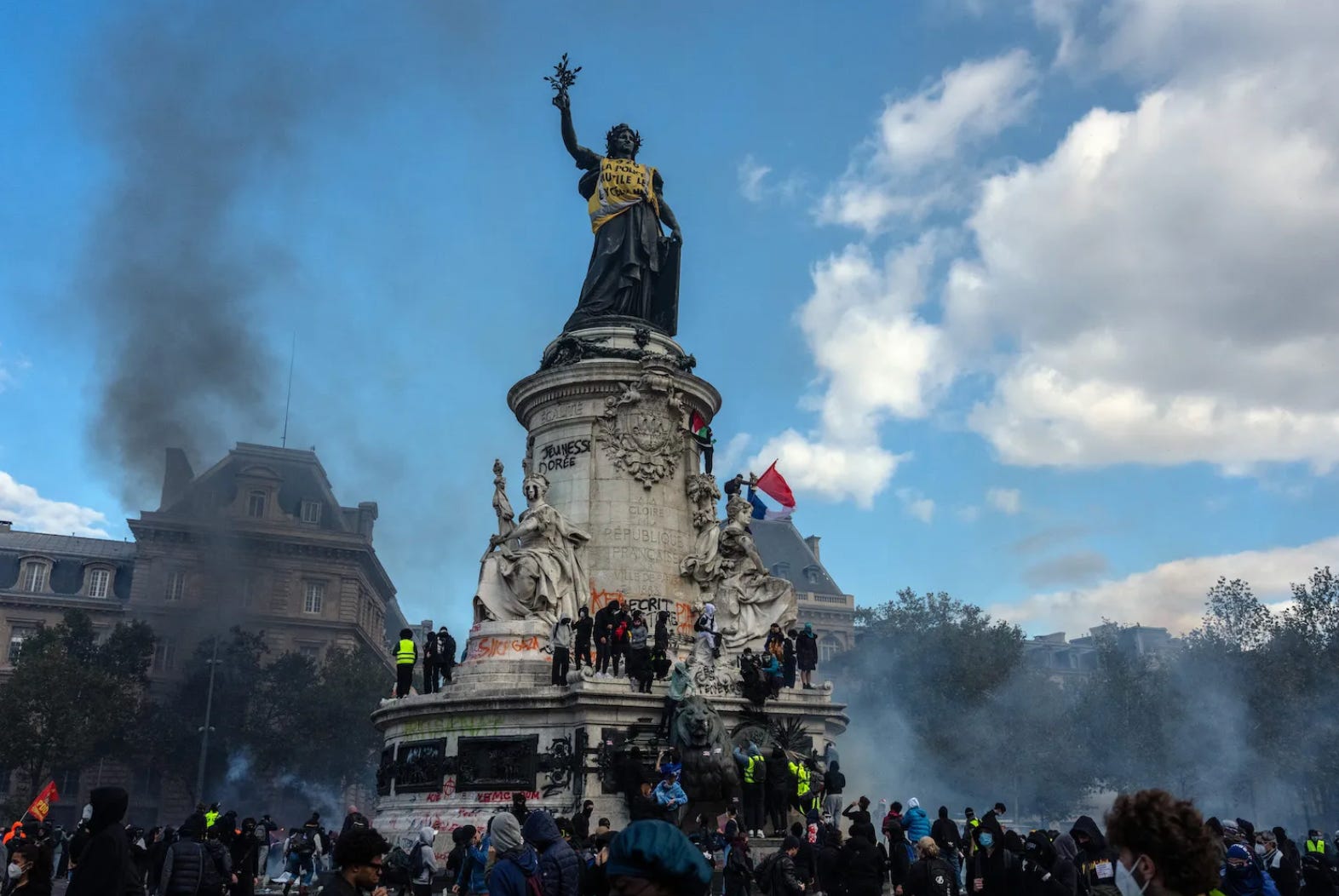
Let’s start with a simple recapitulation of facts, as biased as they may be. Protests in France that began on September 18, 2026, are being driven by widespread student and labour anger over chronic underfunding, staff shortages, and poor infrastructure in the country’s public high schools. A series of demonstrations and blockades by lycée students has been taking place in France and, later, to a lesser degree, in Belgium, Italy, and even Albania. On October 6, the protests developed into a nationwide mobilisation involving students, teachers, parents, and trade unions. Unions estimated that 450,000 people participated nationwide, while the French government put the figure at 250,000. The movement is marked by blockades of high schools, gatherings, and demonstrations. As reasons for participating in the protests, students have cited teacher shortages, overcrowded classrooms, exhausting timetables, run-down buildings, and stress linked to the university application website Parcoursup, as well as classroom temperatures that reached up to 40 °C during the 2026 European heatwaves.
Throughout October, parts of the movement were engaged in violence against police and some management staff, especially headteachers; the French Interior Ministry reported that thousands were arrested. The French government has accused the far left of stirring up the unrest for political gain: the radicalised and criminal minority of the protesters started the violence. Protesting groups and parties, meanwhile, contended that the movement was spontaneous and accused the government and right-wing parties of engaging in conspiratorial thinking. On October 19, a curfew was announced for Place de la République and the streets around Les Halles in Paris, from 20:00 GMT until 04:00 GMT, while the city of Nice imposed a curfew affecting only minors for a similar duration. Lille and three other northern towns – Wattignies, Douai, and Denain – have imposed two-day curfews starting at 18:00 GMT.1 In neighbouring Italy, army units are already deployed in the centre of Milan.
The reactions of the leading politicians are the saddest aspect of the entire affair. Marine Le Pen blamed far-left immigrants and issued calls to restore law and order by all means necessary; Mélenchon issued a series of dubious proposals with no clear idea of how to implement them; and Macron’s public statement was a clear sign of his utter disorientation – a Clintonian “I feel your pain” to protesters, a call for freedom but within the confines of law and order, all this spiced up with an escape from France (a convenient trip abroad when his presence in France would be crucial). Among the utter stupidities, let’s mention just Marine Le Pen’s reiterated demand that the retirement age should be lowered – here is Paul Krugman’s comment:
“You don’t have to be a conservative to see France’s early retirement as unsustainable, especially given that French life expectancy at age 65 is about 87 years of age, 2 years longer than in the US. Thus the fiscal pressure caused largely by France’s very generous government pension plan has led to cutbacks in other spending, notably on education. France is effectively handing over large subsidies to older French at the expense of everyone else. Mass national student demonstrations should come as no surprise.”2
So let’s take a step back and view the protests from a broader perspective: they are to be located in the series of past protests that failed, each in its own way. Exemplary here were the legendary 1968 student revolt and the big gilets jaunes (yellow vests) revolts in 2018. The 1968 protests focused their struggle against what were perceived as the three pillars of capitalism: factory, school, and family. As a result, each domain was subjected to post-industrial transformation: factory work is increasingly outsourced or, in the developed world, reorganised along the lines of post-Fordist, non-hierarchical, interactive teamwork; permanent, flexible, privatised education is increasingly replacing universal public education; multiple forms of flexible sexual arrangements are replacing the traditional family.3 The Left lost in its very victory: the direct enemy was defeated but replaced by a new form of even more brutal capitalist domination. In this way, capitalism usurped the Left’s rhetoric of worker self-management, turning it from an anti-capitalist slogan into a capitalist one. It was socialism that was conservative, hierarchical, and administrative.
The anti-capitalist protests of the ’60s supplemented the traditional critique of socioeconomic exploitation with a new cultural critique: alienation of everyday life, commodification of consumption, inauthenticity of a mass society in which we wear masks and suffer sexual and other oppressions. The new capitalism triumphantly appropriated this anti-hierarchical rhetoric of ’68, presenting itself as a successful libertarian revolt against the oppressive social organisations of corporate capitalism and “really existing” socialism. The final outcome was the growing limitation of the Left to issues of cultural politics – cancel culture and identity politics largely replaced class struggle and visions of a new economic and political order.
The protests of the yellow vests (gilets jaunes) in France signalled the end of this post-1968 pact and the return from cultural politics to particular economic issues. They began as a grassroots movement that grew out of widespread discontent with a new eco-tax on petrol and diesel, seen as hitting those living and working outside metropolitan areas, where there is minimal public transport. The movement has grown to include a panoply of demands, including Frexit (the exit of France from the EU), lower taxes, higher pensions, and an improvement in ordinary French people’s spending power. They offer an exemplary case of the explosion of people’s wrath in all its inconsistency: lower taxes and more money for education and healthcare, cheaper petrol and ecological struggle… Although the new petrol tax was obviously an excuse or, rather, a pretext, not what the protests are “really about”, it is significant to note that what triggered the protests was a measure intended to act against global warming. No wonder Trump enthusiastically supported the yellow vests (even hallucinating shouts of “We want Trump!” from some of the protesters) – he noted that one of the demands was for France to withdraw from the Paris Agreement.
The underlying question here is: when the predominant form of political representation is exhausted, can our political engagement be given new life through a direct awakening of the people? Yes, but the harsh lesson of history is that the difficult point comes afterwards, when the popular enthusiasm has to be transformed into an effective political organisation with a precise programme. With regard to the “chaotic”, leaderless, and decentralised character of the Yellow Vests protests, one can claim that this, precisely, was their strength: they exposed the gap between ordinary experience and political representation. Instead of a clear agent addressing demands to state power and thereby offering itself as a partner in dialogue, we get a polymorphous popular pressure, and what puts those in power into a panic is precisely that this pressure cannot be localised in a clear opponent but remains a version of what Toni Negri called the multitude. If such pressure expresses itself in concrete demands, these demands are not what the protest is really about.
However, at some point, hysterical demands have to translate themselves into a political programme (or they disappear) – the protesters’ demands are the expression of a deeper dissatisfaction with the very liberal-democratic capitalist order in which demands can only be met through the process of parliamentary political representation. In other words, the protests contain a deeper demand for a different logic of economico-political organisation, and here a new leadership is needed to operationalise this deeper demand. I am not afraid to draw here what will be, for some, a terrifying conclusion: we need true leaders to make tough decisions where they cannot be avoided – which group of soldiers to sacrifice on a battlefield, which patient to let die when there are not enough resources, etc. – or, as an old doctor in the TV series New Amsterdam says: “Leaders make choices that keep them awake at night. If you sleep well, you are not one of them.” Paradoxically, the excess that cannot be captured by mechanisms of electoral political representation can only find adequate expression in a leader or a leading body that is able to impose a long-term social and economic project and is not constrained by the narrow period between two elections… Does this sound like universal militarisation? Yes – the forthcoming communism will be a war communism, or there will be none.
The Yellow Vests in France clearly articulated an experience impossible to translate or transpose into the terms of the politics of institutional representation, which is why, the moment Macron invited their representatives to a dialogue and challenged them to formulate their complaints in a clear political programme, their specific experience evaporated. The solution is not for self-organised and mobilised civil society (Podemos, Yellow Vests…) somehow to take over directly and replace the state: the direct reign of the multitude is an illusion; as a rule, it has to be sustained by a strong state apparatus. One should gather the courage and accomplish a Hegelian reversal here: if no political representation can adequately capture what it refers to (the true people’s will, what people really need and want), then this permanent failure indicates that the trouble resides in this very point of reference (what people really need and want).
Remember Trump’s inauguration speech in 2017: “Today’s ceremony has very special meaning, because today we are not merely transferring power from one administration to another, or from one party to another, but we are transferring power from Washington, D.C., and giving it back to you, the people.” Until now, elites were ruling, but: “That all changes, starting right here and right now, because this moment is your moment --- it belongs to you. It belongs to everyone gathered here today, and everyone watching, all across America. This is your day.”4 We should not take these words just as cheap demagoguery but as an indication of what is wrong with the very idea of the direct power of the people.
Maybe what we are witnessing today, with “post-truth” politics, is the end of the entire tradition of a true and authentic people’s will that is then manipulated and misrepresented, but for whose adequate representation we should strive. The way to beat Trumpian populism is not to claim that it doesn’t really stand for the people, that the real people’s will should be allowed to express itself outside this populism. The very fact that people’s will can be “manipulated” in such a thorough way signals its fantasmatic character. Again, in a Hegelian way, the critique of representation should be inverted into the critique of what representation is supposed to represent.
Direct state oppression tends to unite opposition and promote organised forms of resistance, while in “postmodern” societies even extreme dissatisfaction assumes the form of chaotic revolts that soon run out of breath, unable to reach the “Leninist” stage of an organised force with a clear programme. The Yellow Vests protests embodied the weird reversal that characterises today’s global situation. The old antagonism between “ordinary people” and the financial-capitalist elites is back with a vengeance, with “ordinary people” exploding in protests against the elites accused of being blind to their suffering and demands; however, what is new is that the populist Right proved to be much more adept at channelling these explosions in its direction than the Left. Alain Badiou was thus fully justified in saying, apropos of the Yellow Vests: “Tout ce qui bouge n’est pas rouge” – all that moves (makes unrest) is not red. Today’s populist Right prolongs the tradition of popular protests that were predominantly leftist. Yes, tout ce qui bouge n’est pas rouge, but even when it is right-wing populism that bouge, the Left should learn to ruthlessly exploit the crack opened up in the edifice of the existing ideological hegemony by this unrest to promote its own cause.
In contrast to the Yellow Vests, the ongoing 2026 protests have a distinctly leftist tone, which is why this time Le Pen and Trump strictly oppose them, blaming the extreme Left and foreigners; however, to paraphrase Badiou, they ultimately just prove that tout ce qui se présente comme rouge n’est pas rouge. Why not, when the demands are strongly anti-capitalist and only the Left supports them? To understand this, one should take a closer look at Macron’s politics in the last couple of years.
After the 2024 European elections, Macron was caught with a smoking gun, suspending democracy, although he didn’t break any laws but just deftly used the peculiarities of the French constitution imposed by de Gaulle as the founding act of the Fifth Republic’s electoral system. This constitution stipulates that the president nominates the prime minister and the government, which can operate even if they are not confirmed by the National Assembly. It was already Sartre who, for this reason, thought that the Fifth Republic’s constitution wasn’t democratic at all (he even called it a “permanent coup”). The idea was that the French people should be forced to make a choice when they voted, leaving behind that muddled scrum of parties of the Third and Fourth Republics – and if there is no clear choice, the president should directly assert his authority to maintain order and stability.
The 2024 European elections made it clear that French voters didn’t make a clear choice: they didn’t give Macron a chance to forge a clear choice by working to break up the Mélenchon-led New Popular Front while simultaneously drawing in what remained of the Republicans/Gaullists.5 Macron was widely criticised for this, but all parties effectively supported his handling of the situation… No wonder this happened in France, whose political life is full of similar contradictions. Remember the big May 1968 demonstrations, which almost toppled the government (or so it appeared): what was rarely noticed is that these protests took place at the very high point of the French welfare state – never had the standard of living been higher than in the mid-1960s.
In general terms, France is not an exception here: there is a case to be made for enlightened dictatorship – France was just lucky that its constitution allows for the partial suspension of parliamentary democracy. One can just imagine what will happen in Germany if it is not possible to build a government without Alternative for Germany. Take Rwanda, one of the African success stories, with Paul Kagame as its enlightened de facto dictator, who enforced peace between Hutus and Tutsis and brought relative peace and prosperity. If he were to be overthrown, ethnic tension would flare up again in free elections. Western democracy without some limitations is less and less universally applicable, even in the West itself.
So, with all my reservations about Macron’s politics, I think his reaction to the rightist victory came close to an authentic act. Less than an hour after the results were announced, Macron declared the dissolution of the National Assembly and the scheduling of new legislative elections. The announcement caught almost everyone on the back foot – even Macron himself “could not foresee his decision, insisting as late as last month that the EU election had political consequences only for Europe, not France.”6 Macron’s move was risky, but well worth taking: if Le Pen were to win and decide who the next prime minister of France would be, Macron would remain president and retain the ability to eventually mobilise a new majority against the government.
However, with the new elections in July 2024, something totally different happened: not only did Le Pen not get an absolute majority, but her Rassemblement National even finished third, well behind the leftist bloc and Macron’s centrist bloc. The problem was, of course: what to do now? After the defeat of Le Pen, the predominant tone of the comments was best rendered by a CNN headline: “Macron’s gamble has kept the far right out of power, but plunged France into chaos.” The idea was that Macron and Mélenchon (the key figure in the Left alliance) are so far apart politically that no compromise seems possible that would lead to a viable big coalition, so there will be prolonged instability that will certainly unsettle the economy and probably set the conditions for a landslide victory for Le Pen’s Rassemblement National in the next elections. Ominous signs were already emerging – many Jews publicly declared that they would vote for Le Pen since Mélenchon is “sublimely anti-Semitic” (yes, the term was used)…
What we can nonetheless ascertain is that, surprisingly for some, France was not plunged into chaos: for the time being at least, it seemed that Macron’s gamble had paid off, and a semblance of normal life went on without great disturbances – just remember the triumphant Paris Olympic Games. Although this limbo situation with a non-elected government couldn’t drag on indefinitely, it was infinitely preferable to a totally blocked National Assembly that would lead to prolonged political unrest, pushing the country into social and economic chaos. However, it is as if, with the ongoing protests, France is paying the price for the compromises that sustained the appearance of normality in the last couple of years. In short, it is as if the chaos everybody was warning about for years is finally here. Macron has played his last card, and his options are now exhausted – I see no space for another act that would enable a new beginning. The crisis could spread to all of Europe, and we should not even exclude the possibility of a state of emergency extending to many European countries.
The political root of the French crisis is the tripartite division of the political space, which makes a stable political coalition impossible. The old centre is vanishing, becoming marginalised, and the choice between Le Pen and Mélenchon deserves the answer given by Stalin in 1928 when he was asked which deviation is worse, rightist or leftist: “They are both worse!” If Le Pen is elected president, France will become a country of chaos and social tensions since Le Pen will not be able to subdue her enemies; if Mélenchon wins, there will be at least economic chaos. As I see the situation, the problem is that the Left, divided within itself, has no true answer to the crisis, no realistic, consistent programme for coping with the apocalyptic prospects.
Maybe the tensions will get so high that normal elections will be suspended. So I see no direct way out – I hope I am wrong, but I fear I am not. No wonder the crisis exploded in France, where every tough measure proposed by the government is immediately interpreted as a new trick of oppression or exploitation and met with protests. Never has Europe been closer to its self-dissolution than it is now. It is quite probable that the choice will be just between different versions of a state of emergency and that the exhausted silent majority will silently accept some new form of authoritarian rule.
The saddest implication is that both poles in France, Le Pen and Mélenchon, are opposed not only to the European unity that is now needed more than ever but also to continuing support for Ukraine in its struggle against Russian aggression. The logic is clear: helping Ukraine to survive is, for both Le Pen and Mélenchon, a way to spend money that we need to support our own poor… Words matter here: a little while ago, Trump called Zelensky a “dictator” – following his friend Putin, whom Trump has never called a dictator. If the protesters win, this renaming will become our reality – a reality the contours of which are already discernible. After Russia released a retired American teacher who was jailed for allegedly fighting on behalf of Ukraine, US envoy Steve Witkoff praised the decision, calling Mr Putin “a humanitarian”, while also thanking him for a diesel deal that has angered Kyiv’s allies.7 So now we know: the two leaders in the ongoing Ukrainian-Russian war are the humanitarian Putin and the dictator Zelensky…
Let me then conclude with an obvious reproach to myself: what has this pessimistic reading of the ongoing protests to do with a communist vision? My reply: everything, because if the Left does not get rid of the illusions I described in this text, it will deservedly become irrelevant.
https://en.wikipedia.org/wiki/2026_French_student_protests.
https://paulkrugman.substack.com/p/whats-the-matter-with-france.
See Daniel Cohen, Trois lecons sur la societe post-industrielle, Paris: Editions du Seuil 2006.
I am grateful to Kenneth Murphy for this clarification of the legal frame which enabled Macron to act the way he did.
The distinguished professor makes a crucial point by way of Potus’ 2017 address regarding the severe limitations of bourgeois representationalism (whether in its centrist technocratic or right wing populist demagogic varieties…), and why left-wing protest movements that articulate their protest in terms such as “they [elites] don’t adequately represent us… “), while offering no clearly organized alternative structure for handling all the crucial functions of the modern state, are “doomed to failure”, as it were…
However, it seems to me that he either misrepresents or misunderstands (or hasn’t bother to look into—surely not this latter!) what it is that La France Insoumise is as political movement and organization, how it is structured internally, and what the movement’s primary agenda is if they were successful in getting Melanchon elected over Le Pen (by no means a forgone conclusion, mr owl of minerva dude, if i might remind you of your own adages). Both the organizations internal structure—which is decidedly not like the old marxist workers parties, nor is it a multitudinous morass à la Z’s characterization of the yellow vests—and their agenda upon coming into presidential power are directly related to many of the points and concerns Z raises regarding left populist protests of yore. but the latter aspect of the Insoumise agenda is directly related to the very problems of political representation instituted by the fifth republic in de Gaulles “coup d’etat” as described above. Viz that their first and really only order of business upon a hypothetical presidential victory in the upcoming election would be to use the awesome powers of the french executive to dissolve not just the assembly but the entire fifth republic.
to establish a well ordered and democratic process for the drafting of a new constitution, for a sixth republic, by way of country wide constituent assemblies with tiered larger regional and eventually national bodies elected from these former, with all elected regional and national reps being recallable by their originating community (think soviet workers councils as imagined and almost implemented by the sparticists and their various leftist allies during the failed 1918-19 german revolution—perhaps history’s greatest “what if” moment to date—at least in terms of the structure for organizing representational assemblies). This rough outline doesn’t really capture their plans at all, however, for they continue to prove extremely resourceful in terms of their use of social media etc to organize and mobilize and propagate their ideas—as well as, crucially, maintaining robust lines of communication internally among varying levels of leadership and individual cadres, thus helping to avoid the usual headaches of playing the hierarchical telephone game, while simultaneously allowing the movement to maintain a fairly decentralized/grassroots oriented organizational structure with a democratic ethos (of course, within certain parameters, eg those set by the party’s explicitly marxist methodological orientation re the sorts of economic-political analyses feeding into the always evolving particulars of their larger agenda, and well as the generally emancipatory and ecologically sustainable thrust of their long term political program.
Ultimately the idea is to put France on a new constitutional footing that would be adequately responsive to/shaped in the living image of, the actual world as we find it today—knowing all too well what manner of grotesque monstrosities that got us into this mess—that is capitalism, red in tooth and claw, whereby all substantive values (use) melt into air, where cynical nihilism and amoralism reigns supreme, where we and all of nature are but standing reserve for the coming uber mensch for the coming Great Machine, and all notions of home already long since deconstructed to make way for: first, enclosures, then imperialist extraction of hitherto unimagined proportions, finally followed by pure financialization—the ultimate liberation of liquidated value from all material shackles of embodied forms (or so the data centers would have us think…).
Yes, it is more open ended than your typical M-L plan for taking back state power in the name of the workers, which, given our unique historical circumstances, could prove to be a weakness or could in fact turn out to be a strength (only time can tell, if time will tell), but otherwise this seems to me like just the sort of well organized structure/political vision (and indeed in fact even individual leadership!) Zizek seems to indicate he would prefer to see (contra yellow vests & their supposed lack of all three, eg).
Of course, in order to get here we would have to disentangle Melanchon’s Insoumise from the current noble and of course justified manifestations of the youth and worker aligned protest movements, something which this article also fails to do. And in so failing, it in fact propagates the very far right reactionary talking points that le Pen is trying to peddle in order to capitalize electorally on petit bourgeois fear/reactionary backlash. The way in which this conflation is allowed to stand here seems sloppy at best and intentionally reactionary at worst (i will assume out of good faith that it’s the former).
For it is very easy to find out what La France Insoumise is and stands for, at least for anyone of Zizek’s intellect and understanding of socialist history, and with the time and energy and willingness to do the actual research (check out comrade henry wallis’ convo with daniel tutt of emancipations podcast for a solid start!—a few weeks old, but again—Insoumise, while clearly allied with the students causes, is not itself a protest organization. it is a political organization with real political ambitions and a whole well defined (several hundred pages long in fact) program outlining principles and orientation, organizational structure, and short to medium and on into long term goals for the movement. thus what has been presented by its members regarding the Insoumise is not likely to have changed all that much in two or three weeks due to the separately (but dialectically related, of course) ongoing protest movement during that same span of time—though I would not be at all surprised to find that they have been constantly revising and tinkering with short term strategies, messaging, perhaps even having serious internal discussions whether a more significant shift in medium to long term strategy might be in order given latest developments. The last point here is simply that Insoumise is precisely the kind of adequately sophisticated political organization wherein such vitally important internal discussions have been and are being and will continue to be taking place among its members, which then goes into rearticulating and revising its platform and agenda for seizing state power and using it, in ways only made possible by the unique historical legacies of french republicanism and the aforementioned fifth republic’s extreme executive powers in particular, to halt this failing version of the state so as to replace it with a new one drafted by the people themselves (albeit with the theoretical tools and methods of genuine marxist revolutionaries there to help shepherd them, as fellow community members standing and dialoguing and teaching alongside them, or as “expert witness testimony”, if you like, of the sort that we in the so called democratic west have long since recognized is a vital social distinction to make in all sorts of civic bodies, from legislatures to criminal courtrooms (&again—perhaps!—only speculating, but perhaps, with that de Gaulle executive power to back it up… only if need be, given conditions, reactionary opposition, etc… in the form of a red military such as the Paris Commune so desperately lacked… which again brings us right back around to what Prof Z is in fact here advocating, however indirectly…), this with something like a political vanguard made in the image of 21st century informational ecologies rather than in that of 19th century collectivized industries, to serve as rock and rod des citoyens through what would otherwise surely be a terrifyingly chaotic and all too sublimely democratic a process within the various people’s constitutional assemblies… ;)
Of course, one can agree or disagree with this agenda—even on traditional marxist grounds, of course—but any sound analysis of Frances’s current political situation ought to engage with it one way or another, and this article fails to do so entirely. If Comrade Zizek were to be interested in getting around to doing this (which again will require approaching Melanchon’s party with open minded humility of historical materialist research, rather than one-off dismissals by way of dubious historical analogy), I, one of his otherwise quite appreciative and admiring subscribers, would be most interested in hearing what he has to say about it, and why.
I enjoyed the essay, and found its point that the new political movement of the left demands a structured programme and professional leadership which sits outside of the present parliamentary system interesting, but the title suggests that there was some right wing activity in the protests which is not discussed. The paper does talk about the right's adoption of protesting which had in the past been a tool of the left, but again there is really no argument being made that there is any right wing presence in the protests presenting itself as red.