

Welcome to the desert of the real,
If you desire the comfort of neat conclusions, you are lost in this space. Here, we indulge in the unsettling, the excessive, the paradoxes that define our existence.
So, if you have the means and value writing that both enriches and disturbs, please consider becoming a paid subscriber.
Here are just three contingent cases which demonstrate the madness we are in. NASA is elaborating plans for human life and survival on the Moon through the Artemis program, focusing on the lunar South Pole, where water ice and continuous sunlight exist – OK, great, but what we now need much more urgently is a plan for human life and survival on our Earth.
On October 1, 2026, our media reported that “Tennessee death row inmate Christa Pike has been taken to hospital after an attempt to execute her by two lethal injections failed. Her legal team filed an emergency motion to halt the convicted murderer’s execution as it was happening, saying: ‘Ms Pike has lost consciousness and still has a heartbeat and is audibly snoring.’ One of her attorneys told the BBC that the 50-year-old was now ‘being provided life-saving measures’ in hospital after two syringes of pentobarbital had been administered.”1 On the same day, I overheard a hardline rightist in a cafeteria whose comment was: “How could she survive two well-tested lethal injections? Is this not proof that she is a devilish creature who cannot even be killed like an ordinary human being?” Here you get ideology in everyday life – to the reproach that the guy probably didn’t mean it seriously and was just making a bad joke, my reply is: “But that’s my point! Ideology works best when disavowed.”
At exactly the same time, Austrian media reported a weird incident: a 72-year-old hunter wounded a deer and immediately tracked it through thick brush. The adrenaline-fueled animal, fighting for its survival, leaped out and attacked the hunter, injuring his leg… How should this case be treated legally? From the standpoint of recent Israeli actions in the West Bank and in southern Lebanon, the deer should be accused of a terrorist attack. Three small but clear signs of the forthcoming apocalypse.
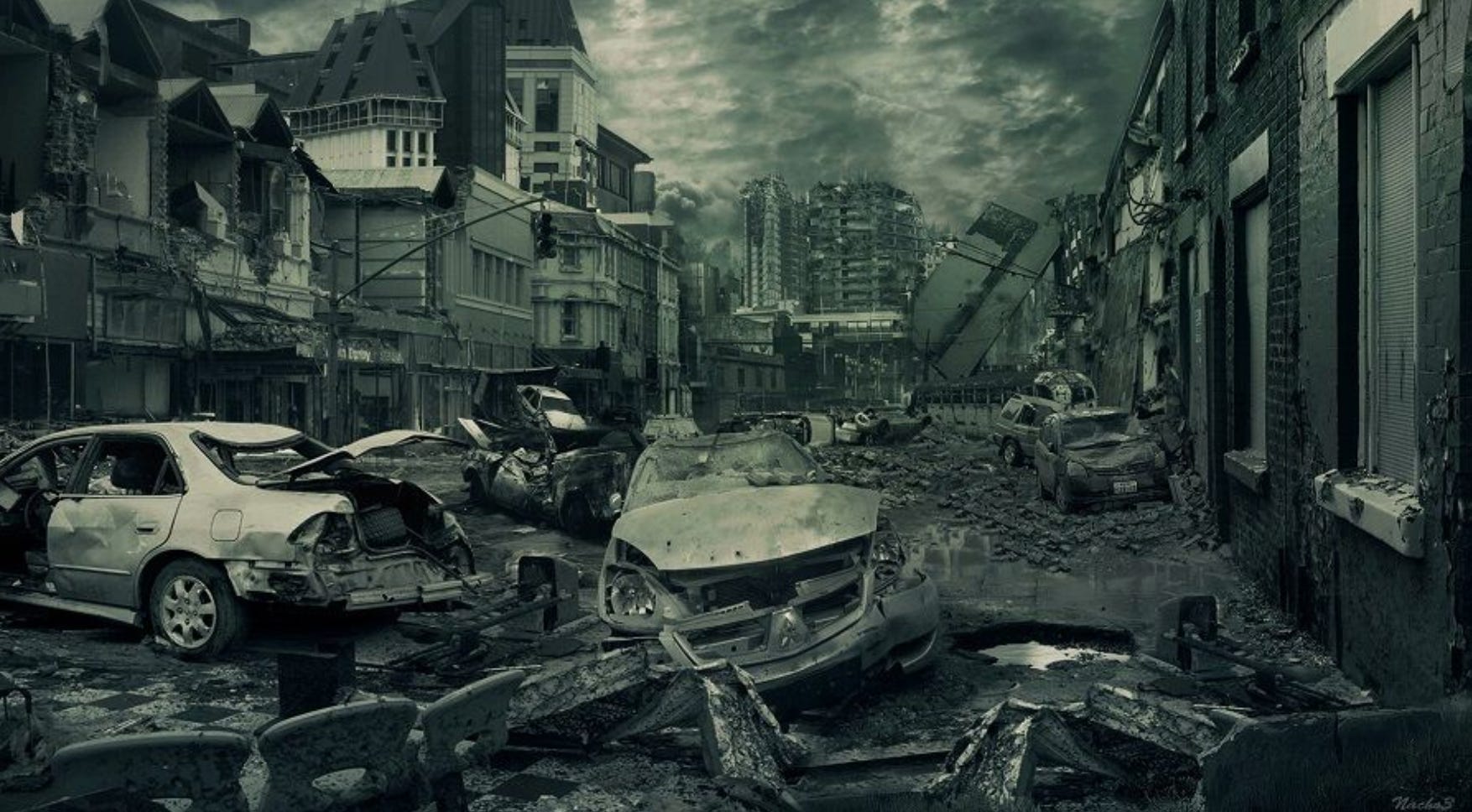
Apocalypse is a general topic omnipresent in our media, so if we want to understand its ideological impact, the first thing to do with it (as with all ideological generalities) is to focus on concrete images and representations that characterize its perception. Those fascinated by a catastrophe, even if it is the end of the world, imagine it as a sudden explosion in which most of us die (nuclear war, AI taking over our lives, a mega-devastation caused by the Earth shifting its axis…). But what if, say, global warming is not a sudden rupture but a (no less inexorable) gradual process: a forced evacuation here, a lack of exotic foods there, signs of social chaos, an occasional lack of electricity, big cities facing water-supply collapse (Kabul, Tehran) or already being gradually submerged in water (Jakarta), our habits of civility gradually drifting towards barbarism, public opinion oscillating between fanaticism and indifference…? Such a process is nicely described in two recent crime novels that both take place in the UK around 2050, one in flooded England (Ian McEwan’s What We Can Know), the other in icy Scotland (Peter May’s Winter Grave).
Today, even the heads of digital corporations claim we need global control over AI NOW – OK, but we do not have an institutional body to impose such control, and we do not even debate seriously how to construct such a body. Plus, who will be held responsible if serious problems arise from our use of and reliance on AI – not just morally, but legally, with grave consequences for them? Nobody is even seriously considering this question.
The trap that lurks here is not new – it is already clearly perceptible in Thomas Piketty’s Capitalism in the Twenty-First Century. For Piketty, capitalism has to be accepted as the only game in town, so the only feasible alternative is to allow the capitalist machinery to do its work in its proper sphere and to impose egalitarian justice politically, through a democratic power which regulates the economic system and enforces redistribution. Such a solution is utopian in the strictest sense of the term. Piketty is well aware that the model he proposes would only work if enforced globally, beyond the confines of nation-states (otherwise capital would flee to the states with lower taxes); such a global measure presupposes an already existing global power with the strength and authority to enforce it. However, such a global power is unimaginable within the confines of today’s global capitalism and the political mechanisms it implies – in short, if such a power were to exist, the basic problem would already have been resolved.
We are in the midst of a new wave of strong nation-state competition which runs directly against the urgent need to establish a new mode of relating to our environs, a radical politico-economic change called by Peter Sloterdijk “the domestication of the wild animal Culture.” Until now, each culture has disciplined/educated its own members and guaranteed civic peace among them, but the relationship between different cultures and states has remained permanently under the shadow of potential war, with each epoch of peace nothing more than a temporary armistice. The entire ethic of a state culminates in the highest act of heroism, the readiness to sacrifice one’s life for one’s nation-state, which means that the wild barbarian relations between states serve as the foundation of the ethical life within a state. It is in the interest of our survival to change such ethics – how?
Kohei Saito is well aware that today ecology is part of mainstream capitalist ideology; everybody (almost) pays lip service to it. This is why Saito’s main targets are not outright deniers of global warming but advocates of “sustainable growth,” the central organizing principle in global responses to climate change. Saito is particularly critical of the Sustainable Development Goals (SDGs), describing them as “the new opium of the masses”: the SDGs disavow the brutal fact that their goals cannot be achieved under a capitalist system. Instead, Saito promotes degrowth, a slowing of economic activity through the democratic reform of labor and production: the transition to a use-value economy, away from an affluent society; decarbonization through shorter working hours for a higher quality of life; the abolition of the division of labor, towards more creativity and meaningfulness; the democratization of the work process, so that decisions will be left to true customers; the appreciation of essential work like caregiving, as opposed to bullshit jobs. Ecosocialist degrowth thus implies the elimination of some sectors of production (arms, advertising, etc.), a radical reduction in other branches (individual automobiles, for example), but also the growth of some activities (education, health care, adequate housing, electrical and water infrastructure in poorer areas or countries, etc.)… Here, however, problems arise. First, Saito
“embraces the vision of local cooperative and municipal initiatives as an alternative to capitalism and state centralism. It is hard to see how Saito’s municipal socialism can paralyze the process of capitalist accumulation, nor is it clear how such local initiatives can provide a coherent alternative if the relations between them are structured through the market, in other words, lacking some form of centralized planning. Ecosocialism requires far more than cooperative or municipal initiatives: it demands democratically centralized planning.”2
To reach the goal described by Saito, strong centralized and even dictatorial measures will have to be taken. So the paradox is that, to effectively slow down, we will have to mobilize in an unheard-of way. Saito knows we need to rehabilitate planning, but this will have to be done in a much stronger sense than he envisages – just think about the strong global measures necessary to cope with global warming, immigration, and the dangers of war, not to mention the traps of the exploding digital control over our daily lives. But, again, how can we achieve this? It would only be possible to move in this direction once our side had already won politically. So, again, Saito’s solution is necessary, but it already presupposes that we have won.
Who, then, is the possible agent of the needed radical change? When Mao’s Communists were coming close to taking power, Mao claimed that their reign would be an alliance of workers, small farmers, the patriotic bourgeoisie, and honest intellectuals. The logic that sustains this series is clear: the exploited workers are, by definition, on our side, while all other terms need a qualification: only small farmers are on our side (the rich farmers exploit the small ones); the patriotic bourgeoisie is opposed to the comprador bourgeoisie, which serves foreign imperialist masters… “Honest intellectuals” is a more enigmatic term. Its basic meaning is clear: intellectuals who are not corrupted by the ruling classes. However, what makes this term suspicious is the moralistic qualification. Today, I think, one should do two things with this list. First, add other items: ecologically exploited aborigines, oppressed races, women and sexual minorities, etc. Second, workers should lose their innocence: many workers exploit their family members to survive; they practice patriarchy and racism; they don’t care about ecology, etc. – MAGA voters predominate among them. The predicate “honest” should thus be extended to all terms: workers can also be “dishonest,” as can the patriotic bourgeoisie (which uses patriotism to justify its exploitation as a service to its own nation) and small farmers (who, in many countries, survive on state support). So there are no privileged emancipatory subjects, neither starving immigrants nor billionaires engaged in charitable work. Should we then draw the sad conclusion that, since we are all in principle threatened, what ultimately unites us is the wish to survive?
Now we are finally ready to address the key question that it may have seemed we were indefinitely postponing: in Freudo-Lacanian terms, the conceptual couple we were relying on is the opposition between the pleasure principle in all its forms (the reality principle, “servicing the good,” global welfare, down to mere survival) and the death drive (in its scientific form, the unconditional drive to know more, independently of the consequences of this knowledge). Is, then, in abstract libidinal terms, our ultimate alternative survival versus the death drive? Should we oppose the threats of radical ethics (which enjoins us to pursue knowledge) with realist-pragmatic appeals to our survival? Should we strive to contain scientific development and the explosion of AI? Should we supplement scientific knowledge with wisdom in order to restore a more balanced world?
I strongly oppose such pragmatic-realist holism: ethics can only be beaten by stronger ethics. It is true that, with cloud-feudalism, the Hegelian dialectic of Master and Servant is returning with a vengeance; however, this in no way means that neofeudals are our new Masters. In the Hegelian dialectic of Master and Servant, the Master becomes what he is through his readiness to risk his life in the struggle for recognition, while the Servant becomes what he is through his preference for survival. Today’s situation is almost the exact opposite: our digital-feudal masters are not heroes ready to risk everything; they are the ultimate survivalists who plan how to continue with their lives even if our reality is destroyed. They build themselves bunkers deep beneath the ground, where they plan to survive for years if necessary; they dream of inhabiting the Moon or even Mars… It is today’s “servants” who are more and more ready to risk even their lives to survive with dignity and freedom.
Today, many intellectuals assume that, in order to understand today’s weird politics, one must always know who is making or losing money and why. But, as Ernst Bloch once said,3 “people do not live on bread alone – especially when they do not have it.” So even a demand for bread is effectively a demand for the dignity of which we are deprived in hunger. The old Clinton motto, “It’s the economy, stupid,” should be replaced by “It’s dignity, stupid.” Recognition and dignity are not only implicit demands in right-wing populist movements; they are the key demands of today’s leftist protests around the world.
So, again, what does this mean in terms of a new ethics? Let’s evoke here an imagined extreme case. I am the leader of a superpower, and my reliable intelligence sources inform me that hundreds of rockets with nuclear bombs are heading towards my state – they cannot be stopped, so I know my country will be totally destroyed in one hour or so. Since my country also has enough nuclear weapons to destroy the enemy, I confront a difficult choice: should I order my army to strike back with full force? If I do this, it will in all probability mean the end of civilization on Earth. So the only truly ethical but very difficult act is to abstain from striking back, with the awareness that, although my country will be erased from the surface of our planet, at least civilization will survive. In this case, I may be remembered as a traitor and coward in my (no longer existing) country, but there is a chance that the rest of humanity will celebrate me as the savior of civilization. However, there is a catch at work here: this ethical choice works only if the enemy does not know about it in advance. If the enemy knows it in advance, it will probably be tempted to drop nuclear bombs on my country, since it knows that my side will not fully retaliate… What this means, unfortunately, is that, in any case, my country has to participate in the arms race.
Such a stance is the opposite of what J. D. Vance said in an interview on September 1, 2026: “While I wouldn’t be shocked if we are living in the end times, what I’m trying to focus on is doing as much of God’s work as possible right now, even if that leads to the end times, OK.”4 The true end of the world is this statement by Vance, especially the words “even if”: they clearly indicate the readiness of an individual to knowingly contribute to the destruction of our entire world by way of doing what he assumes is God’s work. We are used to hearing this stance from Muslim fanatics or from Putin’s ideologists – now we hear it from the vice-president of the US.
In an interview back in September 2023, the Russian general Vladimirov described one of these “fixed points”: “Nuclear war is the ‘inevitable’ conclusion of Russia’s invasion of Ukraine, a Russian general who wrote the nation’s ‘war bible’ has warned. The chilling forecast came from retired Major General Alexander Vladimirov, who penned Russia’s three volume book called the ‘General Theory of War’. ‘For the transition to the use of weapons of mass destruction, only one thing is needed – a political decision by the Supreme Commander-in-Chief [Vladimir Putin],’ the veteran commander warned in an interview with journalist Vladislav Shurygin. ‘The goals of Russia and the goals of the West are their survival and historical eternity. And this means that in the name of this, all means of armed struggle available to them will be used, including such a tool as their nuclear weapons.’ He warned: ‘I am sure that nuclear weapons will be used in this war – inevitably, and from this neither we nor the enemy have anywhere to go.’”5 (OK, but this means that we will all die…) Vladimirov’s option should absolutely not be dismissed as a strategic threat in the ongoing Ukrainian war: even if it is meant that way, it possesses its own logic which can push agents to actualize what they thought was only a threat. Here we are beyond the MAD (mutually assured destruction) logic which functioned well to prevent nuclear catastrophe in the period of the Cold War: mutual destruction is simply presented as inevitable since “neither we nor the enemy have anywhere to go”… One should note the claim that “the goals of Russia and the goals of the West are their survival and historical eternity.” This is why Vladimirov doesn’t speak about Russia’s justified defense against the Ukrainian attack, and even uses the expression “Russia’s invasion of Ukraine” – it is not a question of who is guilty, since we are dealing with Fate, with a struggle to the death in which such minor questions as “who started it?” become insignificant.
A true ethical act here would be to break this Fate, i.e., to draw the consequences from the fact that we are now caught in a struggle to the death with our Fate as described by Vladimirov. What this also means is that we should fully accept the paradox of our situation: no abstract pacifism, no platitudes like “it takes two to fight a war.” We should be ready to risk death in order to avoid the fate which leads to death.
Or rather wrote – see Ernst Bloch, Heritage of Our Times.
I want to make it clear that I am not taking a stand in favor of J.D. Vance or any political party; however, I consider the criticism made to be absurd. The text defends a stronger ethics without saying what makes it stronger, and demands dignity without explaining where it comes from. Without human nature or an objective good, dignity is reduced to a mere slogan. Asking for even dictatorial planning contradicts what it claims to defend. As a Catholic, I recall that Christian eschatology does not command us to speed up the end, it commands us to watch and work, because no one knows the day or the hour. Citing the 'even if' as a desire for destruction is a caricature.
Im sorry, I dont mean to hurt you. Its just that I dont understand why you write so much and incessantly about the same things. Maybe I am ignorant.