

Comrades,
I’m holding a flash sale;
This week, yearly subscriptions will be priced at just $30.00.
That’s less than three dollars a month for all my writing.
Your subscriptions keep this page going. So if you have the means, and believe in paying for good writing, please do consider becoming a paid subscriber.
Below is an essay on religion, psychoanalysis, apocalypse, and the death of God - from Lacan and Tarkovsky to Gnosticism, Hegel, and Blake
Where does psychoanalysis stand in relation to the opposition between religious “enchantment” and scientific “disenchantment” of the world? Science is today’s fundamental fact, while religion and psychoanalysis constitute two responses to it: the “materialist” response, operating at the level of scientific discourse itself—Lacan noted that the subject of psychoanalysis is the subject of modern science—and the “idealist” response, which re-inscribes science within a hermeneutic horizon of Meaning. We should therefore distinguish strictly between hermeneutics, the domain of meaningful speech, and scientific discourse, which articulates what Lacan calls a “knowledge in the real.”
Lacan posits a life-and-death struggle between religion and psychoanalysis, while conceding religion’s hegemonic role in that struggle. The tendency to “domesticate” the real by giving it a sense is, he suggests, part of a quasi-transcendental human disposition:
“If religion triumphs, it is because psychoanalysis will fail. … If psychoanalysis does not triumph over religion, it is because religion is tireless, incredible: it can never drop dead. Psychoanalysis will not triumph; it will survive or not. …
Religion will not only triumph over psychoanalysis; it will also triumph over many other things. One cannot even imagine how powerful religion is.
I just spoke about the real. When science deals with the real, it will extend itself, and religion will find in it many more reasons to soothe hearts. Science means new things, and it will introduce many upsetting things into the life of every one of us. But religion, above all the true Christian one, has resources one cannot even imagine. At this moment, one can only observe how it swarms. It is absolutely fabulous!
The priests take their time, but they understand immediately where their opportunities lie with regard to religion. Their task will be to provide a sense for all the upheavals generated by science. And concerning sense, they know something about it. They are really capable of giving sense to anything whatsoever: a sense to human life, for example. They are educated to do this. From the very beginning, all that religion consists in is giving sense to things that were once natural things. If, thanks to the scientific real, things become less natural, one will not cease to extract sense from them. Religion will give sense to the most curious experiences, those that begin to give even scientists themselves a little bit of anxiety. Religion will provide all this with some juicy sense.”1
The relation between religion and psychoanalysis is thus that between the general field of Sense and its symptom: the point at which the Real intrudes upon this field. Lacan draws the sardonic conclusion that religion will succeed in “curing” humanity of this symptom:
“For a brief moment, it was possible to perceive something that was the intrusion of the real. The analyst stays there. He is there as a symptom. He can last only as a symptom. But you will see that humanity will be cured of psychoanalysis. By way of drowning it in sense—in the religious sense, of course—one will succeed in repressing this symptom. … Religion is made to do this: to cure people; that is to say, to make sure that they do not notice what does not go smoothly.”2
Within psychoanalysis itself, the hermeneutic reaction appears in the guise of Jungian “depth psychology.” The difference between Lacan and Jung may be formulated as the difference between “God is unconscious” and “God is the unconscious.” The former is a materialist thesis: beliefs persist in material practices of which we may be unaware, so that we act as if we believe. The latter is the spiritualist-obscurantist notion of a divine dimension dwelling in the depths of the unconscious.
With regard to materialism itself, we are witnessing a paradoxical reversal. In standard pre-critical metaphysics, “finitude” belonged to materialist empiricism—only material, finite objects really exist—while “infinity” belonged to idealist spiritualism. Today, by contrast, the principal argument for spiritualism against radical materialism relies on the irreducibility of human finitude, understood as the unsurpassable horizon of existence. Meanwhile, radical scientific materialism keeps alive the spirit of infinity.
The usual argument is that the technological dream of total mastery over nature and over our lives is only a dream. Human beings remain grounded in a finite life-world with an unfathomable background. This finitude—this limitation of our horizon—opens the space for proper spirituality. Predominant forms of contemporary spirituality therefore insist that we are not free-floating spirits but irreducibly embodied beings in a material life-world. They preach respect for this limitation and warn against the “idealist” hubris of radical materialism. Ecology is exemplary in this respect.
In contrast to this spiritualist attitude of limitation, radical scientific materialism, which reduces humanity to a biological mechanism, sustains the promise of total technological control over human life: its artificial re-creation, its biogenetic and biochemical regulation, and ultimately its immortality, in the guise of reducing the inner Self to a software program that can be copied from one piece of hardware to another.
It is as if the old materialist insight of Spinoza has thereby received its final confirmation: terms such as “God” are false terms without positive meaning, terms that provide a deceptive positive form for the domain of what we do not know. The religious dimension is explicitly linked to the limitation of comprehension. It does not intimate a “higher” knowledge; rather, it is the inverted assertion of the limits of knowledge.
This is why religious thinkers are drawn to what appear as limits of understanding: do not investigate the biogenetic foundations of the mind, since the result may be the loss of the soul; do not reach beyond the Big Bang, since that is where God directly intervened in material reality. Kant had already stated that he limited the space of knowledge in order to create space for faith.
These two sides of the same coin are clearly discernible in the work of Andrei Tarkovsky. A formal procedure in his films, given his Soviet origins, cannot help but evoke ironically the dialectical “law” of the transformation of quantity into quality, supplemented by a kind of negation of negation. As Sean Martin writes:
“Tarkovsky proposed that if a take is lengthened, boredom naturally sets in for the audience. But if the take is extended even further, something else arises: curiosity. Tarkovsky is essentially proposing giving the audience time to inhabit the world that the take is showing us—not to watch it, but to look at it, to explore it.”3
The ultimate example may be the famous scene in Mirror in which the heroine, a proofreader at a daily newspaper in the Soviet Union of the mid-1930s, runs through the rain from her home to the printing office because she suspects she has missed an obscene misprint of Stalin’s name. Martin rightly stresses an unexpected feature of the scene: its immediate physical beauty.
“It is as if Tarkovsky were content just to watch Margarita Terekhova running through the rain, down steps, across yards, into corridors. Here, Tarkovsky reveals the presence of beauty in something that is apparently mundane and, paradoxically—given the period—also potentially fatal for Maria if the mistake she thinks she has made has gone to press.”4
This beauty is generated precisely by the scene’s excessive duration. Rather than merely following Maria’s run and worrying, within the narrative, whether she will arrive in time to avert catastrophe, we are seduced into looking at the scene itself: its phenomenal features, the intensity of movement, the texture of rain, corridors, yards, and steps.
More generally, Tarkovsky’s films are pervaded by the heavy gravity of the Earth, which seems to exert pressure on time itself. It produces temporal anamorphosis, extending the dragging of time far beyond what appears justified by narrative movement. “Earth” should be given all the resonance it acquired in late Heidegger. Tarkovsky is perhaps the clearest example of what Deleuze called the replacement of the movement-image by the time-image.
This time of the Real is neither the symbolic time of diegetic space nor the time of the reality in which we, as spectators, watch the film. It is an intermediate domain. Its visual equivalent may be the protracted stains that “are” the yellow sky in late Van Gogh, or the water and grass in Munch. This uncanny massiveness belongs neither to the direct materiality of colour stains nor to the materiality of represented objects. It dwells instead in an intermediate, spectral domain: what Schelling called geistige Körperlichkeit, spiritual corporeality.
In the standard ideological tradition, the approach to Spirit is understood as elevation: liberation from weight and gravitation, the severing of links with material inertia, the beginning of a free-floating existence. In Tarkovsky’s universe, by contrast, we enter the spiritual dimension only through direct and intense physical contact with the humid heaviness of earth, or stale water. The ultimate Tarkovskian spiritual experience occurs when a subject lies stretched out on the earth’s surface, half-submerged in stagnant water. Tarkovsky’s heroes do not pray on their knees with their faces lifted to heaven; they listen intensely to the silent palpitation of humid earth.
We can now understand why Stanisław Lem’s Solaris exerted such an attraction on Tarkovsky. The planet Solaris provides the ultimate embodiment of the Tarkovskian notion of a heavy, humid stuff—earth—which, far from opposing spirituality, serves as its medium. This gigantic “material Thing that thinks” gives body to the direct coincidence of Matter and Spirit. A consistent materialism must break with both features: in order to get rid of Spirit, it willingly sacrifices matter itself in its inert density.
The fundamental premise of today’s advocates of the finitude of human existence is this: we are thrown into a world that pre-exists us, a world we did not create and can therefore never fully grasp, control, or dominate. Whatever we do, even in our most radically autonomous acts, we rely on the opaque background of inherited traditions and on the socio-symbolic texture that predetermines the scope of our acts. Hans-Georg Gadamer made the point vividly: the time has come to reverse Hegel’s famous formula concerning the becoming-subject of Substance—the subjective-reflexive appropriation of all our substantial presuppositions—and to undertake the same journey backwards, from the subject to its substantial presuppositions.
This stance belongs within a matrix of four possible relations between subject and world. Subjectivist idealists claim that we made our world and can therefore fully grasp it, since in comprehending it we discern traces of our own activity. Enlightenment scientific materialists claim that, although we did not make the world and although it is an objective reality governed by independent laws, we can nonetheless understand, control, and master it. Ecologists generally share the premise of finitude: we did not create our world; we are thrown into it; therefore we should respect it rather than merely seek to dominate it.
There is, however, a fourth position, rarely acknowledged and the most difficult to understand properly: we created our world, but it overwhelms us; we cannot grasp or control it. This position resembles that of God confronting Job near the end of the Book of Job: a God who is himself overwhelmed by his own creation. This is what dialectics is about. What eludes the subject’s grasp is not the complexity of a transcendent reality, but the way the subject’s own activity is inscribed within reality.
This experience of being overwhelmed by one’s own creation is apocalyptic. Today apocalypse approaches on several fronts: ecological breakdown, informational saturation, and so on. Things seem to be approaching a zero-point; “the end of time is near.” The question is therefore: how does computerisation affect the hermeneutic horizon of everyday experience?
That experience rests on three lines of separation: between “true life” and its mechanical simulation; between objective reality and false or illusory perception; and between fleeting affects, feelings, and attitudes on the one hand, and the remaining hard core of the Self on the other. All three boundaries are threatened today.
First, techno-biology undermines the distinction between “natural” life-reality and artificially generated reality. In contemporary genetic technology, with its prospect of freely selecting sex, hair colour, IQ, and so on, living nature is posited as technically manipulable. In principle, nature as such coincides with a technical product. The circle is thereby closed: everyday hermeneutical experience is undermined. Technology no longer merely imitates nature; it renders visible the underlying mechanism that generates nature, such that “natural reality” itself becomes something simulated and the only “real” is the underlying structure of DNA.
Second, insofar as virtual-reality apparatuses may generate the experience of “true” reality, VR undermines the distinction between true reality and semblance. This loss of reality occurs not only through computer-generated virtual environments but, at a more elementary level, through the growing hyperrealism of images that bombard us in the media. Increasingly, we perceive colour and outline but no longer depth and volume: “Without visual limit there can be no, or almost no, mental imagery; without a certain blindness, no tenable appearance.”5
As Lacan put it, without a blind spot in the field of vision—without the elusive point from which the object returns the gaze—we no longer “see something.” The visual field is reduced to a flat surface, and reality itself is experienced as a visual hallucination.
Third, MUD—Multiple User Domains—technology in cyberspace undermines the notion of the Self, or the self-identity of the perceiving subject. The standard motif of postmodern writing on cyberspace is that phenomena such as MUD make palpable in everyday experience the deconstructionist “decentred subject.” The lesson offered is that we should endorse the dissemination of the unique Self into a multiplicity of competing agents: a “collective mind,” a plurality of self-images without a global coordinating centre, freed from its link to pathological trauma.
Playing in virtual spaces enables one to discover new aspects of “me”: a wealth of shifting identities, masks without a “real” person behind them. It thereby exposes the ideological mechanism through which the Self is produced: the immanent violence and arbitrariness of this production or construction.
These three levels logically follow one another. First, within objective reality itself, the distinction between living and artificial entities is undermined. Then the distinction between objective reality and its appearance becomes blurred. Finally, the identity of the self that perceives something—whether appearance or objective reality—explodes.
This progressive subjectivisation is strictly correlative with its opposite: the progressive externalisation of the hard kernel of subjectivity. The paradoxical coincidence of these opposed processes has its roots in the fact that VR and techno-biology entail the loss of the surface separating inside from outside. This loss jeopardises our most elementary experience of “our own body” in relation to its surroundings. It cripples our standard phenomenological attitude towards another person’s body, in which we suspend knowledge of what lies beneath the surface of the skin—glands, flesh, and so on—and take the surface of a face, for example, as directly expressive of a soul.
On the one hand, inside is always already outside. With the progressive implantation and replacement of internal organs, techno-computerised prostheses—bypasses, pacemakers, and so on—function as internal parts of the living organism. The colonisation of outer space thus turns inward into “endocolonisation”6: the technological colonisation of the body itself.
On the other hand, outside is always already inside. When directly immersed in VR, we lose contact with reality: electromagnetic waves bypass the interaction of external bodies and attack the senses directly. “It is the eyeball that now englobes man’s entire body.”7
Another aspect of this paradox is the way bodily immobilisation overlaps with bodily hyperactivity. On the one hand, I rely less and less on my proper body: bodily activity is increasingly reduced to giving signals to machines that work on my behalf, as when I click a computer mouse. On the other hand, the body is strengthened and “hyperactivated” through bodybuilding, jogging, pharmaceutical intervention, and direct implants. Paradoxically, the hyperactive superman coincides with the cripple who can move only by means of prostheses regulated by a computer chip, like Robocop.
The prospect is that human beings will gradually lose their grounding in the concrete life-world: the basic coordinates that determine self-experience—the surface separating inside from outside, the direct relationship to one’s own body, and so on. Potentially, total subjectivisation—the reduction of reality to an electromechanically generated cyberspace “window”—coincides with total objectivisation: the subordination of inner bodily rhythm to externally regulated stimuli.
It is no wonder that Stephen Hawking became one of the icons of the age: a genius’s mind, or so we are told, within a body almost wholly mediatized, sustained by prostheses and speaking through an artificial computer-generated voice. Hawking’s active contact with his surroundings was limited to the weak pressure he could exert with the fingers of his right hand. His popular appeal cannot be separated from his debilitating illness: the fact that his body, reduced to an almost immobile mass of flesh, continued to function through mechanical prostheses and to contact the world by clicking a computer mouse tells us something about the general condition of subjectivity today.
All these phenomena point toward an apocalyptic zero-point. The only serious question for an authentic Christian today is therefore the following:
“Ours is surely a truly apocalyptic situation, the most apocalyptic situation in our history, one transcending even an original Christian apocalyptism in the totality of its historical enactment. All past historical worlds are now being dissolved, and even all truly natural and sacred realms as well. Yet could such a dissolution be in genuine continuity with an original apocalyptism? Could our contemporary dissolution ultimately be a kenotic and self-emptying dissolution?”8
Nothing appears stranger to us today than apocalyptism. The liberal majority dismisses it as a pathological response to the deadlocks of capitalist modernisation, a sign of the total failure of our “cognitive mapping” of social reality. Yet nothing is a deeper mystery than apocalypse, despite the fact that ours is so clearly an apocalyptic time—the deepest and most comprehensively apocalyptic time in history. What is difficult to grasp is that apocalypse is not merely the catastrophe of creatures: ultimately, apocalypse is the apocalypse of God.
The crucified Jesus is the apocalyptic Jesus. He stands for the end of the world as we knew it, the end of time, when God himself dies and empties himself. At this point of apocalypse, opposites coincide: the lone Jesus is Satan himself; his death is the death of Evil; crucifixion and resurrection are one event. From its beginning until today, such apocalyptism has been “a profoundly revolutionary force in Western history, perhaps our most purely revolutionary power.”
One should recall the utopian fervour that sustained the Bolsheviks around 1920. Despair and true utopia go together: the only way to survive the catastrophic conditions of civil war, social disintegration, hunger, and cold is to mobilise “crazy” utopian energies. This is one of the basic lessons of the much-maligned millenarian movements, exemplified by the German Peasants’ Revolt of the sixteenth century and its leader, Thomas Müntzer. The catastrophe itself must be read in an apocalyptic mode—as the sign that “the end of time is near,” and that a new Beginning is around the corner.
This authentically Paulinian apocalyptic atmosphere is clear in Trotsky’s formulation of revolutionary duty:
“What the Third International demands of its supporters is a recognition, not in words but in deeds, that civilized humanity has entered a revolutionary epoch; that all the capitalist countries are speeding towards colossal disturbances and an open class war; and that the task of the revolutionary representatives of the proletariat is to prepare for that inevitable and approaching war the necessary spiritual armory and buttress of organization.”9
Such outbreaks of apocalyptic revolutionary fervour should also be read alongside their poetic expressions. Consider the most famous poem of the October Revolution: Alexander Blok’s The Twelve of 1918, which follows twelve Red Guards as they patrol a desolate city at night. Its apocalyptic atmosphere echoes Blok’s earlier Symbolist linkage of catastrophe and utopia:
To get the bourgeoisie
We’ll start a fire,
A worldwide fire, and drench it
In blood—
The good Lord bless us!
You bourgeoisie, fly like a sparrow!
I’ll drink your blood,
Your warm blood, for love,
For dark-eyed love.
The famous ending identifies the twelve Red Guards directly with the apostles led by Christ:
So they march with sovereign tread …
Behind them the hungry dog drags,
And wrapped in wild snow at their head,
Carrying a blood-red flag—
Soft-footed where the blizzard swirls,
Invulnerable where bullets slice—
Crowned with a crown of snowflake pearls,
A flowery diadem of ice,
Ahead of them goes Jesus Christ.
In early Christianity, before orthodoxy established itself, the first countermovement to the apocalyptic Jesus appeared in Gnosticism, traces of which may already be discerned in the Gospel of John. Gnosticism promoted the figure of a “Cynical Jesus”: an interpretation of the historical Jesus through a radical wisdom tradition, such as that represented by the Gnostic Gospel of Thomas.
Flights from the apocalyptic Jesus are also flights from the revolutionary Jesus, or from the possibility of historical revolution as such. Gnosticism dissolves not only the full humanity of Jesus but, in doing so, the very possibility of human and historical transformation.
There are, grosso modo, three principal currents in Christianity: centrist “legal” Christianity, the ideology of the Church as a State Ideological Apparatus; rightist, aristocratic Gnosticism; and leftist apocalyptism. This triad loosely corresponds to the historical triad of Orthodoxy, Catholicism, and Protestantism. In its understanding of Christ, Orthodoxy focuses on the Gnostic motif of the divinisation of humanity: “God became man so that man could become God.” Catholicism is clearly legalistic, maintaining God the Father at a distance as Creator. Protestantism violently reasserts the centrality of crucifixion as the death of God.
Further distinctions are necessary. Hans Jonas outlined the difference between two basic orientations of Gnosticism. Both understand history as the history of the Godhead itself, as an immanent divine “devolution.” In both, the Fall is not merely the fall from the Godhead but simultaneously the drama of the Fall—and eventual recuperation—of the Godhead itself. In both cases, the loss of unity between God and creation, the gap that separates them, renders God himself evil: the elevated Master of the world.
Jonas describes the opposition as follows:
“Both dramas start with a disturbance in the heights; in both, the existence of the world marks a discomfiture of the divine and a necessary, in itself undesirable, means of an eventual restoration; in both, the salvation of man is that of the deity itself. The difference lies in whether the tragedy of the deity is forced upon it from outside, with Darkness having the first initiative, or is motivated from within itself, with Darkness the product of its passion, not its cause. To divine defeat and sacrifice in the one case, corresponds divine guilt and error in the other; to compassion for the victimized Light—spiritual contempt of demiurgical blindness; to eventual divine liberation—reformation through enlightenment.”
In the first case, we have what Kant would have called a “real opposition” between two active and positive divine forces, Light and Darkness. In the second, “the fall is quite simply forgetfulness, a cosmic forgetfulness that is the very creation of the world, and the material universe passes into nothingness when the Father is truly known.”
What both versions of Gnosticism cannot accept is the fact that “he was made man”: the full humanity of Christ. This refusal extends even to intimate bodily details. To put it bluntly, some Gnostic accounts insist that Jesus neither urinated nor defecated:
“He was continent, enduring all things. Jesus digested divinity; he ate and drank in a special way, without excreting his solids. He had such a great capacity for continence that the nourishment within him was not corrupted, for he did not experience corruption.”10
A further consequence of the Gnostic stance is the Platonic subordination of ethics to cognition. Evil is ultimately not a matter of free will; it is rooted in ignorance of the Good. One cannot know the Good and remain evil. This is why, in the Gnostic reading of Genesis, the serpent that seduces Adam into eating from the Tree of Knowledge is not evil but a benevolent agent of self-cognition.
Christianity, by contrast, insists that a truly evil person is not ignorant of goodness. He knows goodness from within and is therefore able to exploit it. This anti-Platonic point is made neatly in the classic Hollywood version of The Three Musketeers. When Athos is about to send Countess de Winter, his utterly corrupt but still beloved wife, to her death, he says: “What is the essence of your evil? That you know the secret of the good.”
A thin but decisive line separates this authentically Christian subordination of knowledge to ethics from the perverse denunciation of knowledge as dangerous, or as an obstacle to ethics. In an old Christian melodrama, a temporarily blinded ex-soldier falls in love with the nurse who cares for him. Fascinated by her goodness, he forms an idealised inner image of her. When his blindness is cured, he sees that she is physically ugly. Aware that his love would not survive continued confrontation with this reality, and believing that the inner beauty of her good soul is more valuable than external appearance, he deliberately blinds himself by staring into the sun. He does so in order that his love may survive. If there were ever a false celebration of love, this is it.
What, then, is wrong with Gnosticism? Harold Bloom gives a useful definition of the gap separating it from Christianity:
“If you can accept a God who coexists with death camps, schizophrenia, and AIDS, yet remains all-powerful and somehow benign, then you have faith. … If you know yourself as having an affinity with the alien, or stranger, God, cut off from this world, then you are a Gnostic.”11
The Gnostic solution is the easy one: an easy escape from the paradox of true faith that Bloom describes. Faith always implies a credo quia absurdum.
One must ask the naïve question: why God at all? Why not heroically accept the world of death camps, schizophrenia, and AIDS as the only reality? Why posit a higher Reality above it? The counterargument is that immediate self-experience tells us that we are not “at home” in this miserable reality.
Heidegger’s notion of Geworfenheit, of “being thrown” into a concrete historical situation, may help here. Geworfenheit stands opposed both to standard humanism and to the Gnostic tradition. In the humanist vision, the human being belongs to the earth. He should be fully at home on its surface, able to realise his potential through active and productive exchange with it. As the young Marx put it, the earth is humanity’s “inorganic body.”
Any notion that we do not belong to this earth—that the Earth is a fallen universe, a prison for a soul striving to liberate itself from material inertia—is dismissed as life-denying alienation. For the Gnostic tradition, by contrast, the human Self is not created. It is a pre-existing Soul thrown into a foreign and inhospitable environment. The pain of daily existence does not result from sin, from Adam’s Fall, but from a fundamental glitch in the structure of the material universe, a universe created by defective demons. Consequently, salvation does not lie in overcoming sin but in overcoming ignorance: in transcending the world of material appearances through the attainment of true Knowledge.
What both positions share is the assumption that there is a home, a natural place for humanity: either the noosphere from which we fell into this world and for which our souls long, or Earth itself. Heidegger points a way out of this predicament. What if we are truly thrown into this world, never fully at home in it, always dislocated and “out of joint”? What if this dislocation is our constitutive and primordial condition—the very horizon of being? What if there was no prior home from which we were thrown into the world? What if this very dislocation grounds humanity’s ecstatic opening to the world?
We are thus tempted to reverse the standard theological metaphor of God, who sees the entire picture and knows that what we perceive as a stain contributes to global harmony. The devil is not in the detail but in the global picture: the world in its entirety is a meaningless, cruel multiplicity, while the Good is always partial—an island of fragile order.
There is nonetheless a deep truth in Gnosticism: the idea of a “self-saving” God, a God who himself falls and then enacts his own redemption. Redemption through Christ’s sacrifice is not merely humanity’s redemption, humanity having fallen into sin through the misuse of freedom. It is God’s redemption of himself. Christ’s death is therefore the death, the self-annihilation, of God himself, who at this climactic coincidence of opposites is identical with Satan. Only if Christ is Satan can his death be the defeat of Evil, and thus Redemption.
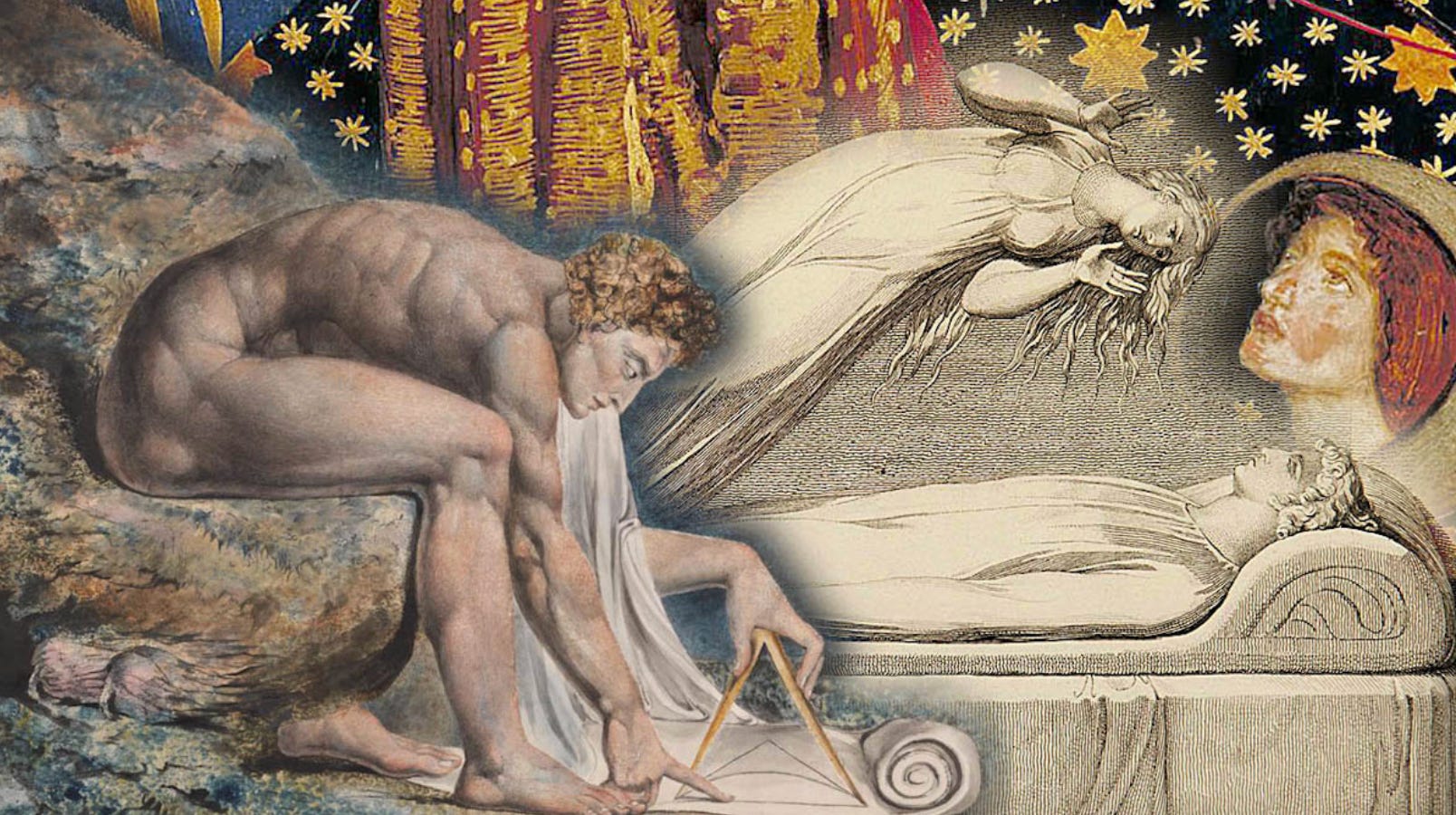
It was William Blake who dared to draw this ultimate conclusion from crucifixion as redemption, conceiving the death of God as “the self-sacrifice of God, a kenotic emptying that is the embodiment of a total compassion, the love that is finally the deepest depth of actuality itself.”
In the history of thought, this speculative identity of opposites was intuited by Meister Eckhart and fully enacted and conceptualised by Hegel. Both “refuse every final distinction between the eternal generation in the Godhead and the kenotic incarnation of Godhead or Spirit.” For both, the Father or Creator is ultimately the Son or Christ, and Christ is ultimately Satan. There is no substantial difference between entities here, only a processual differentiation in which divine Substance empties itself and thereby becomes Subject.
Orthodox Christianity cannot accept even the possibility of the redemption of the Godhead. For Orthodoxy, only humanity is redeemed; redemption has no effect on God as God, who remains absolutely immutable and ineffable. The passion and death of God are thus only the suffering and death of Christ’s humanity. Although the Son of God underwent a real death, Christ died as man, not as God.
The death of Christ is therefore only the death of his carnal body. It has no effect on God as God, who remains absolutely transcendent, immutable, impassive, and unaffected by Christ’s suffering and death. Gnosticism opposes precisely this transcendence: for Gnosticism, the transcendent God-Master is the evil—or, at best, clumsy—Creator. That is, he is Satan himself.
John Milton, perhaps the greatest of Protestant writers, pressed the matter in a different direction. He insisted that there was no genuine scriptural foundation for the dogma of the eternal generation of the Son of God, and that such a generation could only be temporal. Here we are at the furthest possible remove from Orthodoxy. The Son is not part of an eternal Trinity, God’s permanent mystery; Father and Son differ in essence, since the infinite essence of God cannot become incarnate.
Protestantism therefore fully asserts the death of Christ. When Christ died on the cross, he died totally: “his divine nature succumbed to death as well as his human nature.” Only such a full death is the true Event, the sole source of Redemption. The price of this assertion, however, is that God the Father withdraws into absolute transcendence, becoming a superegoic and capricious Master who predestines our destinies—a figure far harsher than the Catholic God of law and just punishment.12
How does the Christian apocalypse—its absolute ending, the death of God—relate to the Buddhist attainment of nirvana? The decisive difference concerns not so much content as form itself. At the level of content, the difference is smaller than it may appear. In both cases, the ending—the end of the world as we know it, of the Law, or of samsara—immediately reverts into its opposite: the eternal blessing of Love. What matters more is the form of this reversal:
“If the crucifixion fully parallels the absolute ‘selflessness’ of the Buddha, it nevertheless is an absolute act or enactment, and therefore the true opposite of an absolute and primordial nothingness. Therefore an apocalyptic Kingdom of God can be known as the true opposite of a Buddhist nirvana or sunyata, just as the kenotic Christ can be known as the true opposite of the kenotic Buddha.”13
Christian crucifixion thus confronts us with an absolute contradiction between content and form. Its content—the self-annihilation of God, and of every substantial Truth—is asserted in the form of a decisive act, a cut between “before” and “after.”
This contradiction emerges in another central difference. Once crucifixion is understood as the crucifixion of God himself, a crucial distinction remains between Gnosticism and authentic apocalyptism. In Gnosticism, the identity of opposites—the reversal of crucifixion into the eternal bliss of redemption—is immediate. The pain of crucifixion immediately becomes bliss because, in Gnostic enlightenment, humanity is directly divinised and the material world literally disappears.
The same applies to Buddhism, which represents the absolute calm of Buddha, the calm of nothingness, in innumerable paintings and works of art. Yet:
“Neither the New Testament nor any subsequent Christian visionary can enact an actual story of the resurrection. The only real action or plot the Christian can narrate is the passion story, for the passion and death of God are the deepest centre of Christianity. … Buddhism can know a full reversal in which passion and death fully and wholly disappear. But even the most exalted Christian art has never been able to envision the actuality of the resurrection, an actuality that is overwhelming in Christian images of the crucifixion.”
This is why Hegel is authentically Christian. For him, the only actuality of Spirit is the actuality of finite life:
“It is in finite consciousness that the process of knowing Spirit’s essence takes place, and that divine self-consciousness thus arises. Out of the foaming ferment of finitude, Spirit rises up fragrantly.”14
For Hegel, the reversal of crucifixion into redemption is purely formal. The art is to see redemption in what appears as crucifixion itself—or, in Hegel’s phrase concerning Luther, to see the Rose in the Cross of the present. The reality of the Cross is the only reality there is. As usual with Hegel, this formal reversal takes the simple form of universalisation: resurrection is nothing but “the universalisation of the crucifixion.”
Blake intuits this speculative high point poetically when he formulates the passage from Law to Love as a passage from external to self-relating negativity:
Satan! My Spectre! I know my power thee to annihilate
And be a greater in thy place, & be thy Tabernacle
A covering for thee to do thy will, till one greater comes
And smites me as I smote thee & becomes my covering.
Such are the Laws of thy false Heav’ns! But Laws of Eternity
Are not such: know thou: I come to Self-Annihilation
Such are the Laws of Eternity that each shall mutually
Annihilate himself for others’ good, as I for thee15.
This self-reflexive turn is, of course, the passage from “spurious infinity” to true infinity: from relating to others and interacting with them, to self-relating. Christ is “actual infinity” because he turns the act of violence back upon himself, sacrificing himself and thereby breaking the endless vicious cycle of reaction and revenge, of the “eye for an eye.”
In this gesture, Christ already enacts universality. He becomes universal in his very singularity, acquiring a distance from his particularity as one person among others. When “each annihilates himself for others’ good,” sacrifice cancels itself and we enter universal Love.
All difficult questions must be raised at this point. Can the horror of the Holocaust, for example, be conceived as divine kenosis? Does such a notion not blur the scandalous edge of that horror, turning it into merely one moment in God’s self-sacrifice and self-redemption?
The answer depends entirely on how divine kenosis is understood. What if kenosis is taken literally, as a genuine self-sacrifice—not as a game God plays with himself while remaining master of its outcome throughout? What if the horror of being an impotent witness to an event such as the Holocaust, in which the world itself falls apart, is divine kenosis in its purest form?
Jacques Lacan, Le triomphe de la religion, Paris: Editions du Seuil 2005, p. 78-80.
Lacan, op.cit., p. 82, 87.
Sean Martin, Andrei Tarkovsky, Harpenden: Pocket Essentials 2005, p. 49.
Martin, op.cit., p. 135.
Paul Virilio, The Art of the Motor, Minneapolis: Minnesota University Press 1995, p. 4.
Paul Virilio, op.cit., p. 113.
Ibid., p. 148.
Hans Jonas, The Gnostic Religion, Boston: Beacon Press 1958, p. 204. From now on, numbers in brackets refer to the pages of this book.
Leon Trotsky, Terrorism and Communism, London: Verso Books 2007, p. 74.
The Gnostic Scriptures, New York: Doubleday 1987, p. 254.
Harold Bloom, Omens of Millenium, London: Fourth Estate 1996, p. 252.
In 16th century, to help the cardinal Albert of Mainz paying off his loan and also to help with the expenses fore St.Peter’s church in Rome, the pope gave Albert a ten years license to sell indulgences of unprecedented potency. What triggered Luther’s fury was the promise that these indulgencies actually work even on future sins. It was thus possible to be pre-emptively absolved of the future sins: after paying the required price, you can commit a sinful act, up to a murder, with a clean conscience – a patent encouragement to sin. No wonder Luther was so enraged by this pre-emptive absolution: the basic protestant attitude is “anything is permitted on condition that you feel guilty about doing it” – here, you dispense of the guilt before the act.
From here on, numbers in brackets refer to the pages in Thomas J.J. Altizer, The Contemporary Jesus, London: SCM Press 1998.
G.W.F. Hegel, Lectures on the Philosophy of Religion, Vol. 3, Oxford: Oxford UP 2008, p. 233.
William Blake, Jerusalem 38:29-36.
I am an unrepentant Zizek-head; enthralled by it all. But this Zizek is my favorite Zizek. I believe this is profound and important. You may say that I am deluded and that it just makes me feel profound and important. I don’t care. I love it!
There are some very disturbing features about the Shadow of God that is very little spoken about in favor of personal shadow , I had a Jewish education in a heretical form of Kabbalah , in our view God is in need of redemption and mankind is created in order to do just that , this conveys greater meaning upon mankind , he would often talk about the holocaust , and the good ( creation of the Jewish State ) that came of something as Evil as the holocaust , and the strange fact that he kept some Jews very close to him like his own doctor .